Yogi Ramsuratkumar
Hilda Charlton |
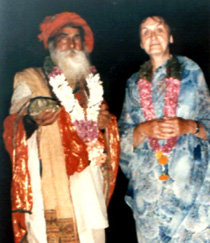 |
There are great gurus in this world, like
Sathya Sai Baba. When he goes into a town, a hundred thousand
, two hundred thousand people will be there to mob the place.
They sing all night. I've been there. I've stayed at a place
where the police had to come to keep calmness and quietness in
the street. There are those beloved such as Satchitananda, who
built the city of Yogaville with his inspiration; the great Anandamayi,
who attracted thousands; the Yogi Bhajans, the Muktanandas that
attract so many. Perhaps many of you belong to them. But there
are some other yogis that some of you might not know much about,
They are not even yogis - they are beyond yogis. They are simple,
quiet people who are hidden and not known, who stay incognito,
who act like beggars, who act foolishly so you won't know they
are anything special. They might throw rocks when people come
near, like Nityananda did at one time so they would think he
was insane. They are people who just hide.
Hidden angels and hidden divinities - It's hard to find them.
I'll tell you later what I think their work is.
I'm going to call on Will to speak. He's going to talk of a great
hidden one he knows who lives near where Ramana Maharshi was.
Some of you may know this hidden one, and others of you may not
understand; may be you passed him and thought, "What a old
beggar". I found him, though I have not yet met him on the
physical plane. I received a letter from him and I saw through
his disguise. I'm not teaching you about another guru tonight.
He's not a guru. He wouldn't have you. His work is universal.
No, I'm not teaching another teacher - I'm teaching a way. You
see, kids, it's very nice to sit here and have Hilda make you
laugh or something, but what if Hilda went at you? What if Hilda
demanded certain things, as I do of some of the people around
me? It's a tough scene, I'm telling you, to be in the presence
of someone like that. They demand something, or get out!
Now, Will, you tell us exactly your experience of this great
one. Yogi Ramsuratkumar is this great one's name. He looks like
a beggar. He carries a crazy spear, he is in rags, he doesn't
bathe and yet smells like roses, and look what he has made of
himself.
Will: "He usually changes his clothes about once a year.
He's a very, very eccentric being, to say the very least. He
dresses as a beggar, he comes on as a beggar. He doesn't have
polish on the outside, except that his eyes and his face are
just totally marvellous, totally unbelievable. The guy walks
like he's walking on two inches of air, as Hilda was teaching
us to do tonight. And he goes very, very quickly, like a locomotive,
so rapidly that Joan, my wife, and I had a very hard time keeping
up with him physically - and we think that we walk very fast.
He would just shoot off in one direction, and it would be very
difficult to follow.
He's a very incredible, beautiful person.
He lives in Tiruvannamalai. There's a set of brass shops near
the temple, and every night at eight o'clock or so, they all
shut down. He sleeps there in the night, and then in the morning
he gets up and usually goes out near the railway station. He
sits under a very, very small tree, and he does his work.
"He's unknown to the world, and most of the people around
there think he's just totally nuts. He walks around. He sings.
He has this big staff. It looks like a bow and arrow with peacock
feathers. He finds strings and ties everything, everything, on
the strings. He just carries that around, holds it and sometimes
he'll say, 'Sita Ram, Ram Rain Sita Ram, Jai Jai Sita Ram.' The
kids love him. They all come out to be near him, and he says
that within three days he can have any kid be his best friend.
I've seen it. They come out and they say, 'Ram! Ram!, He says
'Govinda Ram!' Within a few days of this, even the little Muslim
kids say, 'Ram! Ram!' too. And their parents look at them very
strangely.
"Anyway, Yogi Ramsuratkumar is a total child, and that's
the major thing. I don't know what his physical age is - he may
be about sixty. But he's just a kid, just a really joyous, joyous
kid at heart. I've seen him get up in the middle of the night
and sing 'Rama Rama' and dance in ecstasy. And then sit down
again, within the total bliss of it all. When he sings, he sings
with his whole being.
"I'll relate to you when I first met
him. We heard a lot about him from our friend Caylor. Yogi Ramsuratkumar
apparently knew us. He had told Caylor some information about
our natures and what we were to do in this life. He already knew.
When Caylor took us to see him, he was under a small shrub bush,
a very small pine. It was very hot. He would always keep us in
the shade by moving us around. When we met him, he was very,
very thankful. We had done something which he considered a favour,
so he very, very sweetly told us how much he was indebted to
us. And we said 'No, no. It is our pleasure to serve you.' Then
he looked at me for a while, and he put his hand up. I was sitting
may be two or three feet away. And he just put me into a really,
really deep ecstasy. I closed my eyes and I saw light coming
out of my head, and I was way out of my body consciousness within
about a minute. And then he said, 'Mr. Will, Mr. Will don't go
that side, come back, come this side.' And I couldn't come down,
I just couldn't.
"Then he said, 'Ohhh, not so good to go that side. 'He said,
'No good cigarettes on that side."
Hilda : Understand, kids, that Yogi Ramsuratkumar smokes because
his teacher told him to smoke to stay down, like Shirdi Sai Baba
did, like Ramakrishna did.
Will : "And then he said a very strange thing. He repeated
four numbers. He said, 'Two, nine, zero, eight.' And immediately
I was back in my body, just instantly, and I had my eyes open.
He said, 'Oh-ho, so that's your number.' He wrote it down on
a piece of paper, circled it and gave it to me. I was trying
to get the meaning out of him. I said, 'Swami, what is this number?
Is this my room number in heaven?' He just cracked up all over
the place. He said, 'Oh, no. Oh, this sinner just did something
in his madness. He doesn't know what he did.'
"He always refers to himself as 'this beggar, this madman'.
'He never uses the first person. I think maybe once during our
stay of eight months did I hear the word 'I'. It was a very,
very special night, Shiva Ratri or something like that.
"Once there were people really hassling him. Politically
he wasn't very well liked because he was advocating the unity
of India, and at this time this particular state had advocated
secession from India, and the local government was not very sympathetic
to Indira Gandhi or the central government. Yogi Ramsuratkumar
said, 'India must be united. India must be whole. It must be,
to do its work on the Earth.' They were really hassling him one
day, and it was a very, very gruelling day, and I said, 'Swami,
why do you take this? Why do you do this?' And he said, 'This
beggar's here not to defend his ego. He's only here to do the
Father's work.' And that's really a lesson for me, because we
all feel what we do is right and we push ourselves and we force
ourselves - and he merely said he's not here to defend his ego.
"He does work in very strange ways. Sometimes we would order
tea. He would have somebody to go out and get the tea, or Joan
or I would go get the tea. But sometimes he would serve the tea
himself. You would think it wouldn't be any big deal just to
serve the tea. But when he served tea, he would place the cups
exactly. If there were five of us, he would serve one here, and
then go over and serve another one there - in no seeming order
whatsoever. Once I made the mistake of moving my cup a little,
and he just stopped and said, 'This beggar put that cup there
for a purpose, and he knew just what he was doing.' Then he walked
around and walked around and held his beard like this, and just
walked around with this very, very, very determined look on his
face. He walked around and held his staff up and walked around
some more, and then finally he came back. And then, after the
tea was about cold, he served it. And he said, 'Well, this beggar
did what he could.' After that I never ever did that again, and
I really followed his instructions to the letter because he was
just too severe when I didn't.
"To be put down like that once, I tell you - I never wanted
it to happen again. It's very, very, very severe, his tone of
voice, his whole look at you - it's something that bums through
you. You just can't face it. Once I said something, and he thought
I shouldn't have said it. I was going to defend myself, and he
just put his hand up to stop me. And I stopped right there. So
he went at it for a while, and then finally in my mind I just
let it go, and he stopped. He was very, very severe. Whenever
you did something that wasn't conscious, that wasn't in harmony
with his work, he would really make you regret it. You would
feel so bad, and yet you couldn't do anything about it. But that's
the way you learn, unfortunately - or that's the way some of
us learn.
"In the morning after we got up, we usually went and spent
the afternoon or the evening with him, but then he would send
us away at night. Once we had the grace to spend two full weeks,
night and day, twenty-four hours a day, with him. I think I went
home once; I was out of his sight for an hour. It was really
intense, and I really learned a lot. But I also went through
a few trips about it.
"For his bath he carries a coconut bowl, just a little shell
of a coconut, cleaned out and dried. That's his water pail, so
to speak. He drinks out of it, he eats out of it, he washes with
it. He fills it full of water, then splashes it over his face,
throws a little over his head, and the guy looks like he's just
had a bath that cost a million dollars. He is just so radiantly
beautiful.
"Then he assigns everybody to carry something. He always
had big bundles of newspaper all tied up in burlap bags. Sometimes
there would be four huge bags. He would never throw them away,
and he would just carry them around. He usually had two Indian
devotees there. They were very, very well disciplined, and very
sweet people. Once when he assigned me to carry some thing, I
made the mistake of saying, 'Swami, i don't want to carry that.
Let me carry this.' No. You did only exactly what he said. Sometimes
he would have you carry nothing, and it would be seemingly unfair
because somebody else would have such a tremendous load, and
you would be walking around with nothing, feeling like a real
fool. But he would say, 'It doesn't matter. You're doing something
else for me.'
"Once we were walking down to go out to this field where
we usually went. In South India there are a lot of rice paddies
with little dams between them, and those very thin dams are the
paths you walk on so that you don't spoil the crops. We are walking
with him, carrying our big burdens early in the morning, by the
beautiful holy mountain Arunachala. We weren't being so observant
- we were so enamoured with the beauty of the mountains, the
beauty of the fresh air, the beauty of the crows and all the
birds and everything. He stopped dead on the path, and Joan was
in front and she hit right into him, and I hit into her. It was
like the Marx Brothers. He really gave it to us for that. He
said, 'This beggar doesn't want you to think about any mantras.
Don't think of any gurus. Don't even think of God. Be observant
and do what he says to do.' He said, 'We have this work to do
nicely and that's all you have to be concerned with.' We really
learned to be aware after that.
"He would use the staff in a very nice
way. We might be going down the street, and he would put his
staff up and say, 'Stop. Go over to the side.' And just that
second a car would turn around the comer. His political enemies
had tried to run him over about three or four times, so he was
a little conscious about that. They had knifed him a few times,
too. Once they knifed him and he just rubbed his hand over the
wound, saying, 'Rama, Rama, Rama' and it was healed.
"He used to place little things around Tiruvannamalai. He
would smoke a pack of cigarettes and then throw down the wrapper.
Then just before we left, maybe about three or four hours later,
he would pick the wrapper up again and put it in his pocket.
His pockets were just bulging with all kinds of things, every
little thing imaginable. He never threw out anything. Even his
old clothes were in the sack he carried. And then he would place
little things around Tiruvannamalai. He would look for the exact
place, the exact time to put something, and then he would put
it there, and a few days later he would come back and get it.
It would be right there, and he would put it in his pocket again.
He never threw anything out.
"Once he had this little sack tied up in his clothes. I
said, 'What's in this little sack?' He took it out, and it was
some nellika, which is like a very salty little nut. Then he
said, 'Oh, I didn't know I had these'. He made us eat them and
they were very, very sour. And he said," Oh, these are so
good for you, really so good for you.' So we really had to be
on our toes.
"His awareness was really fantastic. Once a girl from Canada
came to see him. She was sitting op- posite to him, and Joan
and I were sitting on the side, facing another direction. It
was about midnight. In Tiruvannamalai they have a lot of owls,
and in the distance, in the direction that Joan and I could see,
a little owl came and perched on a very, very far roof. It was
there for about a minute and flew off. And the very next thing
he said to the girl was, 'Tell me. Do you have owls in Canada?'
We were just astounded because we had been sitting there so quietly,
and then we noticed the owl. He wasn't even facing in the same
direction that we were. He would have had to see it out of the
far, far comer of his eye, and yet it seemed as if he were giving
this girl all of his attention.
"Being with him was really a lot of fun. He used to make
fun of himself constantly. He would call himself 'this beggar,
this madman.' Caylor told us that once when he was with him,
before he could say anything, Swami said, 'Oh, you're thinking
this about this beggar and that about this beggar.' He was dumbfounded
because that's exactly what he had been going to say. He just
sat down, shut up and was very quiet for a while."
Hilda : Thank you, Will. Joan, would you say something about
Yogi Ramsuratkumar? Is this interesting to you, kids, to hear
about a different kind of a yogi, hiding behind rags? I'll tell
you afterwards what I believe he does.
Joan : "I feel it's such an honour just to get a chance
to talk about Yogi Ramsuratkurnar. I can hardly believe this
opportunity that's been given to us. I know that the beggar in
Tiruvannamalai would probably weep joyous tears at the thought
of people in another part of world, so many hundreds of us, thinking
about him and talking about him.
"Will told you about the teacups that were misplaced. My
first experience with his sternness came one evening when the
two devotees Will had spoken about had gone back to their homes
because they had some work to do there. They weren't able to
stay overnight with him. As usual, we had come from the field
into town and had settled ourselves on the stone platform, where
we were talking. We had some tea together, and when the shops
began to close, Swami said that it was time to move now, meaning
that we should move all the things over to the place where he
slept every night.
"This one particular night he was having to work with just
Will and me, who were not very aware, although we'd been with
him for some weeks. He said, 'This beggar will try to do this
nicely, but there may be some difficulty.' So slowly we took
those huge burlap bags filled with newspapers and no telling
what else over to the spot where he slept. After we got ourselves
moved over there, we just sat quietly and lit a candle because
it was very dark. Everything was just so quiet, so peaceful.
Then Swami said, 'Joan!' And I came to attention. He said, 'You
can do some work for this beggar,' and I was thrilled. He said,
'Pannal isn't here. You can unroll my bed. 'Well, his bed - one
would never suspect it as it was only a roll of burlap rags -
was stuffed away underneath the shelf that a shopkeeper had kindly
let him use. He began to explain to me very carefully how I was
to do this work. I was just so excited about the opportunity
to do something like this for him, something more than carrying
newspapers or whatever. Except I always especially liked to carry
his staff. He told me in detail how I was to proceed about this
work and said, 'Don't get up now. This beggar will explain how
you must do this nicely.' I sat there, all the time thinking
in my mind that I knew how to roll out a bed, because we had
sleeping bags and I knew how to unroll those. I waited patiently
until he explained it all to me. And then he said, 'Now you can
do this'. So I got up and went over to the burlap bag and began
to unroll it according to my own idea. He jumped up and said,
'What are you doing?' I said, 'Well, Swami, I'm..uh..you know..'
And he said, 'Sit down.' I was just mortified. I said, 'Swami,'
trying to continue, but again lie said, 'Sit down.' So I sat
down. I tried to defend myself by telling myself that lie hadn't
spoken clearly. Of course, the truth was that I hadn't heard
what he was telling me. Then after some minutes of silence which
felt like hours to me, he said, 'Mr. Will, Joan thinks this beggar
is very arrogant.' I was shocked because I'm sure I was thinking
he was very arrogant. And then he became very serious once more,
and he explained so I understood. He said, 'After sometime, when
you've been with this beggar, sometimes he treats you differently.'
He explained that, and for the first time I realized that if
we were going to stay there with him, I was going to have to
really listen and follow the instructions he was giving me, because
these instructions, though they didn't seem very important, were
really, really important. Hilda has enlightened us even more
about the meanings behind them.
"Once when we were in the field, sitting under the tree
that Will spoke of, we had the honour of helping him write a
letter to a man who had been to see Yogi Ramsuratkumar and was
a devotee of Sathya Sai Baba. He had since gone back to Europe.
Swami said, 'I must write to Sri Raman today. 'Any casual observer
would think, here's this mad fellow, this beggar, just sitting
under a tree, and he should have plenty of time for everything.
But his work was so intense. Can you imagine that he only changed
clothes may be once in six months? I remember once he had on
a new set of clothes and he looked glorious. But he said, 'This
beggar, this sinner, had no chance to get a bath.' There just
wasn't time for him to spend on himself to take a bath.
"So he began to write a letter to Sri
Raman, and we were speaking about the things that Sri Raman had
written to him and what things Swami wanted to tell him. The
letter was written nicely. Then it got to be about five o'clock
and we heard the evening whistle, so he said we should be going
and told me to take care of the letter. 'Here, hold this letter,
and carry it,' he said to me very firmly. 'Just hold it and carry
it.' But I began to think on my own that if we walked along the
dirt road, the path that we usually followed, I would probably
have it spoiled by the time we had to mail it. So I said, 'Swami,
I have a good idea.' He didn't like my saying this, but he was
very nice. He said, 'Yes, what is it?' I said, 'Swami, why don't
we put the letter between the newspapers and I'll carry it in
the newspapers. Then when we get to the post office, it'll be
in perfect condition.' He mumbled. 'This beggar thought it would
be better if you hold it, but all right, do it your way.' So
I thought, 'Oh, boy, it's going to be in perfect condition.'
I put it in the newspapers and thought no more about it. I got
to carry a few more things also, and we stopped to sit on a rock
near a farmhouse where he was known to the people who lived there.
Parmal, his devotee, was alerted that he would be taking the
letter to Sri Raman to mail at the post office. Swami said, 'Joan,
give me the letter.' I opened up the newspapers, but by some
horrible accident the letter had slipped down the newspapers,
and my hand - it was hot weather, you know - had spoiled the
edge. It was torn. That was the first thing he saw, the tear
in the letter. It was just horrible. To make matters worse, the
two men who were with him all the time were laughing! Swami said,
'This beggar will do what lie can, but it won't be the same.
He'll do what lie can. He'll make some lines on the letter, but
it won't be the same."
Hilda : Thanks, Joan. Caylor, speak just for a second or two.
Loud and clear.
Caylor : "I went to India in the spring of 1970. For about
six years I knew him and frequently went to see him. He's a fantastic
being, and the longer I'm away from him, the more I feel this
in my heart. I'll tell you the way we met, the beginning of it
all."
"At that time he had lived in Tiruvannamalai
for about thirteen years. No one knew him except for just the
few village people who understood who he was. He avoided people.
He walked for miles on the highways in a state of trance. He
would sit in graveyards for days and days and not eat, just to
avoid people so he could be doing his work.
At this time I was eager to do some meditation in India to really
profit from my stay there. I was like so many of the devotees
of Ramana Maharshi who sat in the meditation room for five or
six hours at different times of the day, However, I started to
have tremendous pressure in my forehead. It would move up to
the top of my head and my head would feel as if it were being
pressed in a vise. I couldn't stand it. I couldn't sleep, I couldn't
sit still, and I couldn't think. Nothing seemed to stop it. I
went from one person in the ashram to another, but no one seemed
to be able to help me, no one. I was astonished that there wasn't
someone there who could do that work or understand it.
"So finally I went to an old French woman in the ashram
who'd been in Tiruvannamalai for about seven years. She knew
one person, she said. But oh, no, I'd never find him - she couldn't
even find him. I asked her again the next day when she was walking
on the hill at sunset, and she said, 'All right, I'l1 watch for
him tomorrow when I go to the bazar.' The next day she went and
she saw him there. You know, it was as if he were waiting for
her, because otherwise she never would have round him. He told
her to bring me to the temple at five o'clock the next evening.
"So there I am waiting at five minutes before five, and
here he comes, with about a half dozen little kids all prancing
around him. He's just ecstatic, he's just floating, and the kids
are all dancing, and they're so happy together. Finally we sit
down, and he gives me some flowers, and I give him the flowers
I have. He asks me some questions about where I'm from and so
on. I tell him about my problem, and he tells me to come back
alone the next day to the bazaar, to a little stone-carving shop
where they make tiny little deities. The next day there he tells
me to sit still and not to think about anything. He puts his
hand on my head, and for the first time in months, suddenly this
whole pressure just disappears; it's gone. He explains that it's
probably going to come back in two weeks and that if it does,
I should find him again. How? You know, it didn't occur to me
that I'd have to find him, that I'd have to really hunt.
"So in two weeks the pressure came back. I prayed and I
prayed that I'd be able to find him, and I designated that he
would be under the main archway into the temple, where I had
left him two weeks earlier. That evening I started off early,
and it was storming by the time I got there. There are thousands
of people selling things on the streets of India, and every one
of them was stuffed under that archway. It was just incredible.
How was I to find him? He would never be there with so many people
- and be wasn't. So I ran out into the street and I ran here
and I ran there. I looked in tea shops, I looked everywhere -
I was desperate. Finally, alter about half an hour, I ran out
into the street, turned around and there he stood, inches from
my nose. He jumped away and said, 'Mr. Caylor, what are you doing
here?' And I said, 'Oh Swami!' and I grabbed him and hugged him.
He took me to the tea shop where we sat and talked about American
Indians for about half an hour, just to get my mind off my problems.
Then he put his hand on my head again, and it went away. And
I've never had that problem since. But that's how it all began.
"And then began a long process of learning things like Will
and Joan have told you. I learned how every single thing he touches
- even if it's a cigarette butt or the package or a twig he plays
with or a string that he's taken off a little wrapper of food
- anything he's ever touched you can't just throw away, because
there's power in there. There's something: there's an essence,
there's a quality. It may be months before he finds time to empty
his pockets and place everything where it will do some work.
It takes a long time to see him doing these things. He doesn't
talk about them. He's a beggar. He calls all these things his
'madness.' He loves to talk about how bizarre he is . It's really
remarkable.
"You have to learn little things - like when he's talking,
you can't interrupt. It took me time after time of interrupting
to learn this. After hours of sitting with him, he would be in
a sort of abstracted state, and he'd have me talk about a particular
subject. It was always different, but always specific. For a
half hour, an hour, an hour and a half, he would ask me questions,
and I would keep going. After the day had gone by, my head would
be so tight that I couldn't take any more from him. I'd have
to go out and be away for a while. But as this was going on,
if I tried to change the subject, suddenly he'd stop and say,
'We'll talk about that later.' He'd ask me another question.
He explained once, and I finally understood, that to stop him
and to change the subject was like derailing a train going at
sixty or ninety miles an hour. He's intensely involved in a certain
work. And to suddenly change the subject is to leave all that
up in the air. You know how we feel when we're working and somebody
interrupts us. But he works on so many different levels all at
one time that to just simply change the subject - what does it
do to that man? It's astonishing.
"When we walked with him or when we sat with him, he was
always so conscious of where every one was. We all had to be
in a certain arrangement. He'd think a long time about where
he would put us before we would even get to sit down. And if
I let somebody walk between us while we were walking in the bazaar,
it would upset him. It upset his body physically. He would remind
me, 'Please don't allow anyone to break us up.' We would have
been working together for days, hours, on whatever it was.
"He talked about himself a little bit. One very beautiful
story is that one morning, as usual, he was going to a little
shop in the bazaar where he bought cigarettes - but maybe be
went at that time knowing who was going to be there. He saw an
old sadhu also buying something, maybe some cigarettes too. And
this sadhu takes from the shop owner what he had asked for and
turns around and looks at Swami and says, 'Who are you?' Swami
takes a step back, and he looks at him as he does out of the
comer of his eye, and he says, 'I am who you are. And who are
you?' It was this joyous occasion of two Masters meeting, and
they both knew it was this little leela, this little miracle,
right in the bazaar. They embraced.
"I've written some things about him, beautiful things I
think, and he used to love to have me read them over and over
and over. He would say, 'You know, this beggar is only the dust
at the Lord's feet. And you have taken this soil and you have
made it into some mud. That's all I am, this beggar's just mud.
And you have shaped it and fashioned it like a master crafts
man into some beautiful, beautiful statue. He would say, I can't
ever thank you for what you've made of this beggar.' To hear
him talk like this - well, I don't know what to say.
Once or twice late at night he has said to me that he is a Master.
And he has said something very beautiful which I always remember.
He said, 'I am infinite and so are you and so is everyone, my
friend. You see only a small part of the real man, like a man
standing on the seashore of a great ocean and looking out, sees
only a small portion of that great ocean. Like that, you see
only an infinitesimal part of me.' And he said, 'I am Infinite.'
Hilda : Thank you very much. Thank you.
What I wanted to say was that to me, those who work like that
are working with the Infinite . Do you comprehend what he was
doing, kids, when he put a teacup here and one over here and
one over here and one over here and nobody could move them? He
was working with the Infinite. Do you understand? Do you comprehend
at all? He was placing something that had power to change the
world. He might have been working with religions. He might have
been working with countries. He might have been working with
ideas. But he was shaping things. And he once said to Joan, "Watch
this world in twenty-five years." What did he say, Joan?
Joan: "He said if we were to just stop our existence now
and wake up again in twenty-five years, the glorious world that
we would see in twenty-five years we wouldn't even recognize.
We wouldn't believe that it was the same world we had once been
in.
Hilda: See, do you understand what he was doing? What these silent
ones, these people who are never known to you, do? They don't
have big crowds, they don't have Yogavilles. I'm not downing
any of that, kids. I'm not downing the hundreds of thousands
following well-known yogis. I'm not downing any of it. But there
are the invisible ones at work, and I've always said it's these
people along with the other great ones who keep the world in
balance.
He takes a stone and puts it here. He has a reason. He puts a
thought behind it. And he hides behind his craziness; he hides
behind his laughter. But he's stem, stem, so stem you have to
do it just right. And people don't understand - why can't you
just do it sloppy?
Why not? Because when he puts a stone there, he's placing it
for the universe; he's placing it for the world. He's changing
the world with his thoughts, with his power. I tell you, I've
had a letter from that man, and he calls himself with every other
word, "this old sinner, this old beggar." Well, if
he's a sinner and beggar, he's the most beautiful 'sinner and
beggar in this universe. He's powerful! If he puts a stone down,
he changes the world!.
He reminds me somewhat of Shirdi Sai Baba, who would go out on
the temple porch in the afternoon and nobody would go near him
because he was doing his universal things. They aren't funny,
these strange people.
These hidden angels, these great ones, help hold the world in
balance. Perhaps they appear mystical to some, foolish to others,
insane in the minds of the earthly sick ones who are tied to
customs. Oh, we have a custom, you mustn't wear rags, no, no.
Mustn't tie pieces of rock in your clothes. You'll end up in
Bellevue with a psychiatrist saying you mustn't tie rocks in
you dress. That's not nice, that's not the way humans do things.
You've got to do it just the way everybody else does. Well, these
great ones don't. Their ways break the rules of cultures. But
to me they are the sacred ones who sacredly work for their brothers
and sisters unnoticed - except that I brought it out into the
open here, with all my heart. And he knows it this night. He
knows it. I'm going to write him and tell him that people in
the second biggest cathedral hall on the Earth heard all about
you, Swami.
To these hidden brothers and sisters of light,
let us humbly bow. They care not for fame, for recognition, but
quietly walk through life as God's beacons of truth and light.
And I sang out from my soul with them as I awakened this morning,
and I heard these words. They were wonderful as I awakened. "I
love life'" I said, in all its diversities. I love giving,
I love receiving, I love the sun, I love the moon, I love the
mud. I love the hardships. And I love the glory. Yes, I love
life, God's life in all its diversities and forms. And best of
all, I love the Formless One."
Yes, these hidden ones, kids, these hidden ones work that way.
Let me know that there are a few hundred here that understand
things beyond their ken, beyond their mind. I had a hard day
today, but I came here laughing, laughing like a fool. New people
will say, "What is that crazy woman up there laughing about?"
Nope, the hidden ones like Yogi Ramsuratkumar are not crazy.
He knows just what he's doing for the universe - and he's changing
the universe. I know when I work in the funny way that I work
- if 1 never saw you kids again and never left my room, I'd still
be working for the universal as I do with the Master Pericles.
Watch the papers for the results of the work we here are doing
for Greece, for Egypt and for Israel. I have somebody else watch
the papers. I don't read them. I'm not like the great ones carrying
newspapers. Now do we know what he's got in those newspapers?
Maybe he is carrying the world in those newspapers! Do you understand?
And we say he's nuts.
Well, I'm telling you, let's change our ideas of right and wrong
this night, shall we? Let's get up out of our strait-jackets.
Let's change those ideas of what's right and wrong this moment
and know that some- where in India or in the mountains here are
great ones - hidden - never seen by you or me, perhaps, but who
are keeping our world in balance.
(Extracted from SAINTS ALIVE by Hilda Charlton.
Publishers, Golden Quest, Woodstock, New York.)
(Courtesy TATTVA DARSHANA - 1990) |